


Most merchants expect one flat monthly price and then open their first invoice to find more. Shopify fees come in layers: the plan itself, a card rate on every online sale, an extra charge if you skip Shopify Payments, and a long tail of add-ons. Knowing how those layers stack before you commit can save hundreds of dollars a year. This guide covers every fee Shopify charges, shows which of the fees Shopify applies you can avoid entirely, and gives you a break-even calculation so you can pick a plan based on your own sales volume instead of guesswork.
Think of your bill as three separate layers:
- Subscription fee: the fixed monthly or annual price of your plan.
- Payment fees: the card rate on each sale, plus an extra Shopify charge if you use an outside payment provider.
- Ecosystem costs: apps, themes, domain, email volume, POS upgrades, and chargebacks.
Most “surprise” Shopify costs come from layers two and three, not the plan price.
Shopify subscription fees
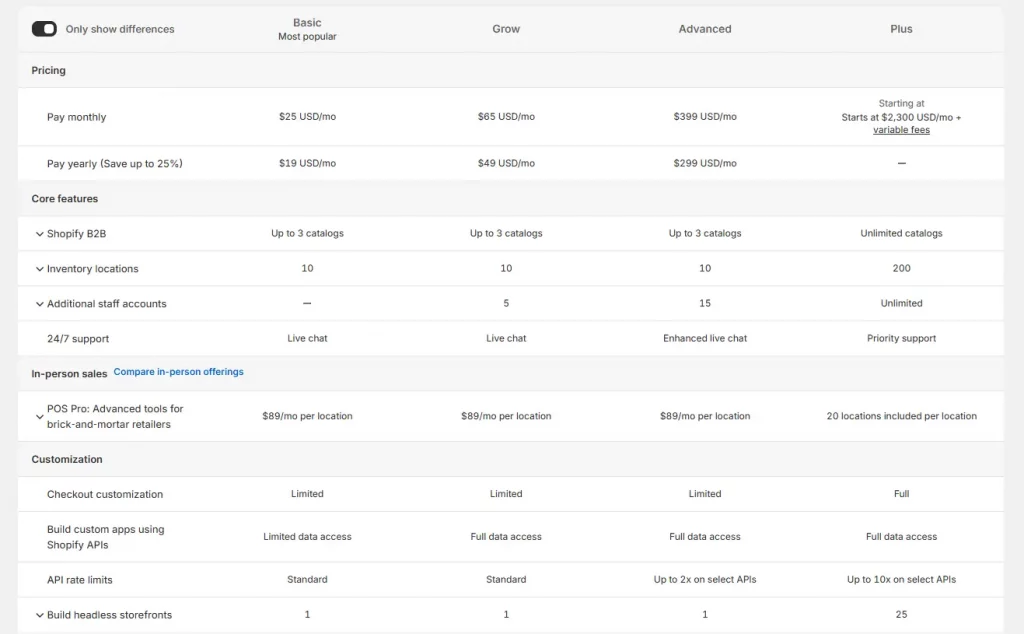
Shopify’s plans are priced lower if you pay annually. Billing yearly saves roughly 10–12% on Basic, Grow, and Advanced.
| Plan | Monthly billing | Annual billing (per month) | Best fit |
|---|---|---|---|
| Starter | $5 | $5 | Selling through social and messaging links, not a full store |
| Basic | $25 | $22 | New stores |
| Grow | $65 | $58 | Stores with steady sales and a small team |
| Advanced | $399 | $359 | High-volume stores |
| Plus | From $2,300 | Custom contract | Enterprise brands |
Two details matter more than the headline price. First, annual billing is paid upfront and a mid-term cancellation does not earn a prorated refund, so many merchants start monthly while building the store and switch once they are committed. Second, new stores can try Shopify free for 3 days and then pay $1 per month for the first 3 months on Basic, Grow, or Advanced. Promotions change, so confirm the current offer on Shopify’s pricing page.

Transaction fees and Card processing fees
This is the area where people confuse two different charges, so it is worth separating them.
- Payment processing fee (card rate): charged on every online sale, regardless of provider. It pays for the card transaction itself.
- Third-party transaction fee: an extra fee Shopify adds only when you take payments through a provider other than Shopify Payments.
Shopify Payments card rates (US)
| Plan | Online card rate | In-person card rate |
|---|---|---|
| Basic | 2.9% + 30¢ | 2.6% + 10¢ |
| Grow | 2.7% + 30¢ | 2.5% + 10¢ |
| Advanced | 2.5% + 30¢ | 2.4% + 10¢ |
Starter carries a higher online rate of 5% + 30¢, which is why it suits only very small social sellers. Plus rates are negotiated.
The extra fee Shopify charges for outside payment providers
If you use an outside provider instead of Shopify Payments, the fee Shopify adds on top of your provider’s own charges is:
| Plan | Third-party transaction fee |
|---|---|
| Basic | 2% |
| Grow | 1% |
| Advanced | 0.6% |
| Plus | 0.2% |
Some payments are exempt. According to Shopify’s Help Center, when Shopify Payments is active, you are not charged this fee on orders processed through Shopify Payments, Shop Pay, or PayPal Express, or on manual methods such as cash on delivery and bank transfer. On Plus, the fee is waived when Shopify Payments is your only provider.
One trap: if you run a direct third-party card provider and Shopify Payments side by side, Shopify says payments handled by Shopify Payments (for example Shop Pay) are charged its standard rate plus a 1.25% premium. Mixing providers can cost more than choosing one.
Shopify Payments is only available in supported countries. If your business is registered elsewhere, an outside gateway may be your only option, and the third-party fee becomes a fixed cost of doing business. In that case, the plan decision below matters even more.

How to choose a plan
Revenue thresholds you see in many guides are rough rules of thumb. A more reliable method is to compare what an upgrade costs with what it saves in payment fees. Using annual pricing:
| Upgrade | Extra plan cost per month | Break-even sales if you use an outside gateway | Break-even sales if you use Shopify Payments |
|---|---|---|---|
| Basic to Grow | $36 | About $3,600/month (1 point lower fee) | About $18,000/month (0.2 point lower card rate) |
| Grow to Advanced | $301 | About $75,000/month (0.4 point lower fee) | About $150,000/month (0.2 point lower card rate) |
A worked example. A store on Basic sells $10,000 a month through an outside gateway. The 2% Shopify fee costs $200 a month. On Grow, the fee drops to 1%, or $100, and the plan costs $36 more, so total Shopify-side cost is $136. The upgrade saves $64 a month even before counting the extra features.
Two takeaways follow. If you use Shopify Payments, your plan should be driven by features such as staff accounts and reporting, because the card-rate savings only pay off at high volume. If you rely on an outside gateway, upgrading earlier is usually worth it, because the percentage gap between plans is much larger. These break-evens ignore the fixed 30¢ per order, which is the same on every plan.


Hidden Shopify costs
These Shopify costs rarely appear on a pricing page, yet they decide your real monthly bill.
| Cost | What to expect | Recurring? |
|---|---|---|
| Apps | Commonly $50–$300 a month for a working marketing and operations stack; more for complex setups | Yes |
| Premium theme | One-time payment, roughly $100–$500 in the Theme Store (free themes also exist) | No |
| Custom domain | Roughly $9–$14+ a year through Shopify, free to connect one bought elsewhere | Yearly |
| Shopify Email | 10,000 emails free each month, then about $1 per 1,000 | Usage-based |
| Shopify POS Pro | $89 a month per location; POS Lite is included in every plan | Yes |
| Chargebacks | $15 per dispute in the US, refunded if you win | Per incident |
Apps deserve the most attention because they are the cost merchants underestimate. A store rarely stops at one: reviews, email, upsells, loyalty, and inventory tools each add a subscription. Before installing anything, ask whether Shopify already does the job. Order documents are a good example. Shopify’s native Order Printer needs HTML, CSS, and Liquid knowledge to customize templates, while a dedicated invoice app such as Vify Order Printer PDF Invoice lets you build branded invoices and packing slips through toggles, with a free plan available to test before you pay.

Frequently ask questions
How much are Shopify fees per sale?
It depends on your plan and payment provider. With Shopify Payments in the US, online card sales cost 2.9% + 30¢ on Basic, 2.7% + 30¢ on Grow, and 2.5% + 30¢ on Advanced. If you use an outside provider, Shopify adds a fee of 2%, 1%, or 0.6% on top of your provider’s charges.
Is there a fee Shopify charges if I use PayPal?
Usually not when Shopify Payments is active, because PayPal Express is exempt from the third-party transaction fee in that setup. If Shopify Payments is not available in your country, PayPal runs as an outside provider and the plan-based fee applies.
What is the difference between a transaction fee and a payment processing fee?
The payment processing fee is the card rate charged on every online sale. The transaction fee is Shopify’s own extra charge for using a provider other than Shopify Payments. You can avoid the transaction fee but not the processing fee.
Does Shopify charge a setup fee?
No. The plan includes hosting, SSL, unlimited products, and checkout without a setup charge. Costs such as domains, paid themes, apps, and POS Pro are separate.
How can I reduce Shopify fees without changing plans?
Use Shopify Payments, avoid splitting volume across providers, pay annually, and audit your apps. These four steps cut fees on every plan without sacrificing features.
Conclusion
Fully understanding all Shopify fees is essential if you want to build a profitable store without unexpected expenses eating into your margins. By choosing the right plan for your revenue stage and carefully evaluating the tools you actually need, you can optimize your Shopify costs and scale your business more efficiently. The better you understand Shopify’s fee structure now, the easier it becomes to make smarter financial decisions as your store grows.
For Shopify stores looking for a professional invoice solution that’s easy to customize without any coding, Vify Shopify Order Printer app is worth considering. Try it for free today and see how it fits your store’s needs.