


Choosing the right Shopify marketing agency can be challenging when so many agencies offer similar services but specialize in very different areas. A partner focused on paid advertising may be ideal for a high-growth DTC brand, while a smaller store may benefit more from SEO, content marketing, or conversion optimization. This guide compares five common agency models, their specialties, pricing approaches, and ideal use cases, helping Shopify merchants identify the right type of partner based on their store size, growth stage, and marketing goals.
What does a Shopify Marketing Agency do?
A Shopify marketing agency helps stores attract customers, increase conversions, and retain existing buyers. Its role is different from that of a development agency, which focuses primarily on building, maintaining, or improving the Shopify store itself.
Shopify marketing typically covers several core areas, including SEO, paid advertising, email and SMS marketing, conversion rate optimization, creative content, and analytics. However, most agencies specialize in a few of these areas rather than delivering every service at the same level.
| Service Category | What It Covers | Typical Provider |
|---|---|---|
| SEO | Technical SEO, collection and product page optimization, content, link building | In-house SEO team or specialist agency |
| Paid media | Meta Ads, Google Shopping, Performance Max, TikTok Ads, YouTube | Paid media specialist or full-service agency |
| Email & SMS retention | Klaviyo or Postscript flows, campaigns, segmentation | Retention specialist or full-service agency |
| Conversion rate optimization | Landing page and product page testing, checkout audits | CRO specialist or paid media agency |
| Creative & content | Ad creative, UGC, brand content, video | In-house creative team or full-service agency |
| Analytics & attribution | Tracking setup, dashboards, attribution and incrementality testing | Full-service agency or analytics partner |
A store rarely needs every one of these services from a single provider. The more important consideration is how closely an agency’s expertise matches the store’s current growth priorities. Looking beyond a long list of services also helps reveal what an agency actually specializes in.
Shopify Marketing Agency vs. Development Agency vs. Generic Digital Agency
Searches for marketing agency Shopify services often lead to several different types of companies. Although their websites may use similar terminology, their roles can differ significantly.
A Shopify development agency focuses on the store itself. Its work may include theme customization, app integrations, store migrations, and Shopify Plus development. A generic digital marketing agency works across multiple ecommerce platforms and may support Shopify alongside platforms such as WordPress or BigCommerce.
A Shopify marketing agency has a more specific focus on growing businesses within the Shopify ecosystem. Its marketing strategy takes into account Shopify’s product pages, collections, checkout experience, apps, and integrations. This platform knowledge can also make it easier to work with tools commonly used by Shopify merchants, such as Klaviyo, Recharge, and Judge.me.
| Vendor Type | Primary Focus | Best Fit |
|---|---|---|
| Shopify development agency | Build, migrate, or maintain the store | Stores needing development, migration, or custom app work |
| Generic digital marketing agency | Marketing across multiple platforms | Businesses operating across several ecommerce platforms |
| Shopify marketing agency | Traffic, conversion, and retention for Shopify stores | Established stores looking to improve growth |
The distinction matters because marketing problems and development problems require different expertise. A store with a strong technical foundation but weak customer acquisition may benefit more from a marketing specialist than another development partner.
5 types of Shopify Marketing Agencies to consider
Rather than ranking agencies based only on popularity, it is more useful to compare different agency models. The five examples below represent distinct approaches to Shopify and ecommerce marketing, giving you a clearer idea of what each type of partner offers.
1. Full-funnel DTC growth agency: Common Thread Collective
Founded / HQ: 2012, Southern California.
Best for: Established DTC brands with approximately $10 million to $100 million in annual revenue.
Core services: Paid social, Google Ads, creative strategy, and email/SMS retention.
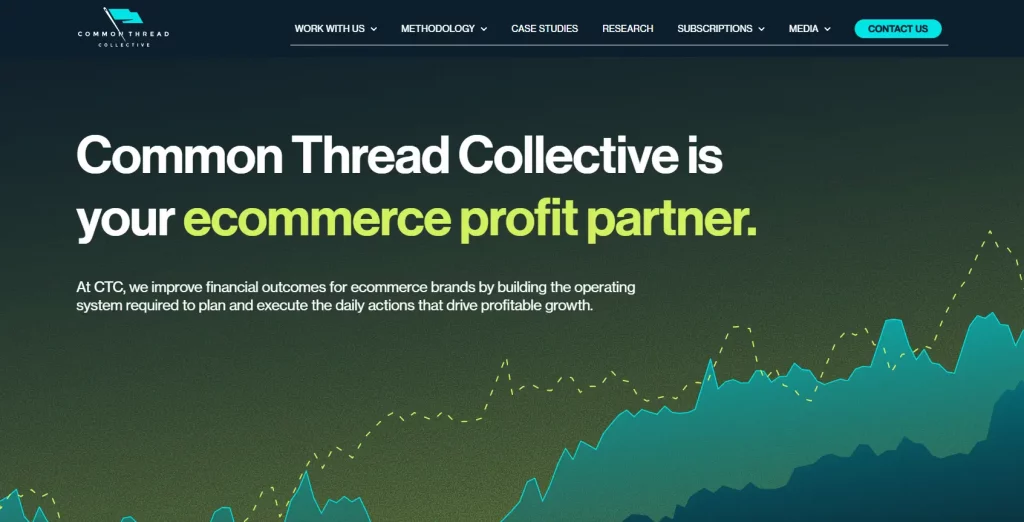
Common Thread Collective takes a full-funnel approach to DTC growth. Its framework connects traffic, conversion rate, customer lifetime value, and variable costs to overall profitability. The agency also operates its own portfolio of DTC brands, giving its team direct experience with ecommerce operations alongside agency work.
Its pricing is customized based on the engagement and is generally aimed at brands that already have a meaningful advertising budget. This model is less suitable for early-stage stores that are still testing their first acquisition channels.
For smaller brands, the main limitation is scale. CTC is designed to support established businesses rather than stores that are still in the launch or early-growth phase.

2. Flexible à la carte agency: Hawke Media
Founded / HQ: 2014, Santa Monica, California.
Best for: Growing brands looking for senior marketing expertise without building a large in-house team.
Core services: Paid social, SEO, email, creative, PR, influencer marketing, and CRO.
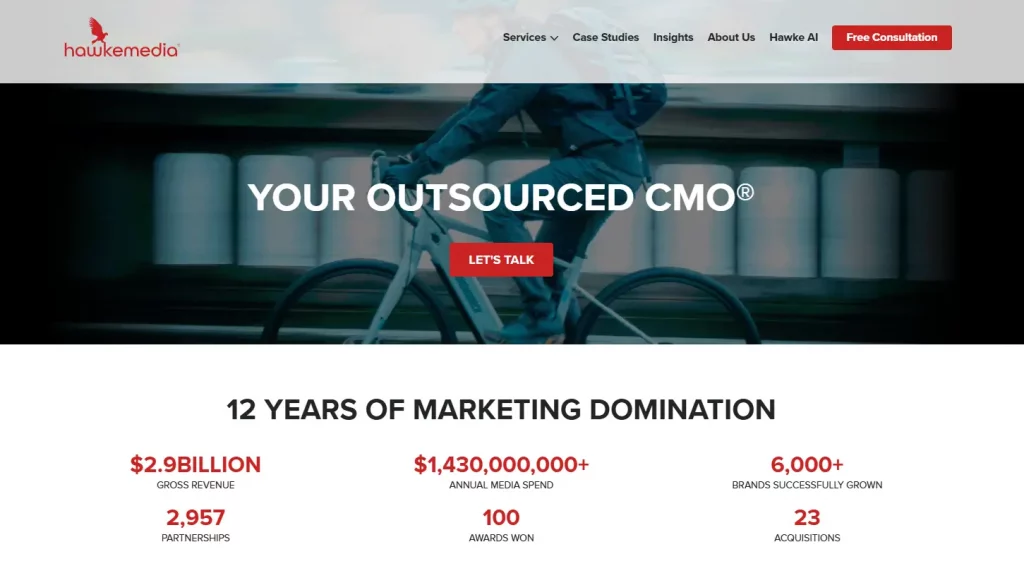
Hawke Media follows an outsourced CMO model that allows brands to select individual marketing services instead of committing to a fixed full-service package. Its month-to-month structure provides more flexibility for businesses that need to adjust their marketing priorities as they grow.
The agency also uses its proprietary Hawke AI analytics platform across engagements and reports having worked with more than 4,700 brands.
The flexible structure is useful for businesses that need several marketing capabilities but do not want a long-term, bundled engagement. At the same time, channel depth may vary depending on the account team, making this model less suited to brands looking for one highly specialized team to own a single marketing channel.

3. Paid media and CRO specialist: Disruptive Advertising
Founded / HQ: 2012, Utah County, Utah.
Best for: Brands that need stronger PPC and conversion rate performance.
Core services: Google Ads, Meta Ads, Performance Max, TikTok Ads, and landing page or product page CRO.
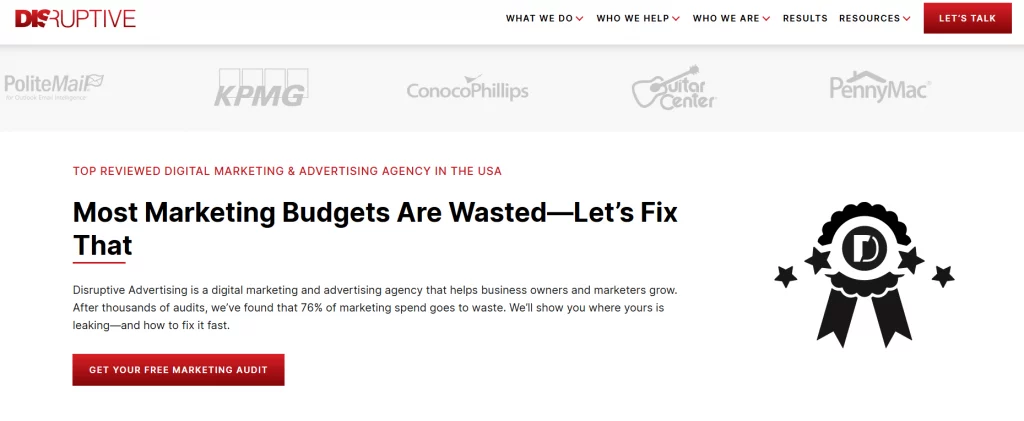
Disruptive Advertising focuses heavily on paid acquisition and conversion optimization rather than offering a complete marketing department. Its approach begins with auditing advertising accounts to identify inefficient spending before increasing budgets.
The agency also has dedicated ecommerce leadership focused on Shopify and DTC accounts. Pricing typically follows a flat retainer or percentage-of-ad-spend model, which is common among paid media specialists.
This type of agency works well when advertising efficiency or conversion rate is the main growth challenge. However, SEO, retention marketing, and creative production may still require separate internal resources or specialist partners.

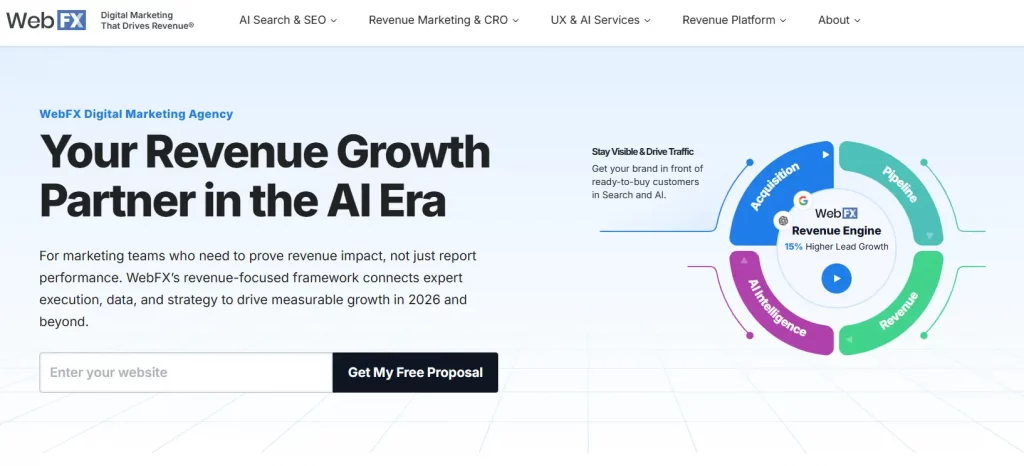
4. Full-service agency with proprietary technology: WebFX
Founded / HQ: 1996, Harrisburg, Pennsylvania.
Best for: Brands looking for a full-stack Shopify digital marketing agency with strong reporting capabilities.
Core services: Shopify SEO, PPC, web design and development, CRO, and email marketing.
WebFX provides a broader range of services under one roof, making it a potential fit for businesses that want to consolidate multiple marketing functions with one partner.
One of its key differentiators is its proprietary MarketingCloudFX and RevenueCloudFX platforms, which are designed to connect marketing activity with revenue reporting. The agency states that it has generated more than $10 billion in client revenue over five years and has an average rating of 4.9 out of 5 across hundreds of independent Clutch reviews.
Pricing is customized based on the service, website size, and project scope. Its large scale provides extensive resources and reporting capabilities, although brands looking for highly personalized founder-level involvement may prefer a smaller boutique agency.

5. AI-search-native growth agency: NoGood
Founded / HQ: 2016, New York City, with a Miami hub.
Best for: Brands looking to improve visibility across traditional search and AI-driven discovery.
Core services: SEO, AEO/GEO, paid search and social, CRO, content, and lifecycle marketing.
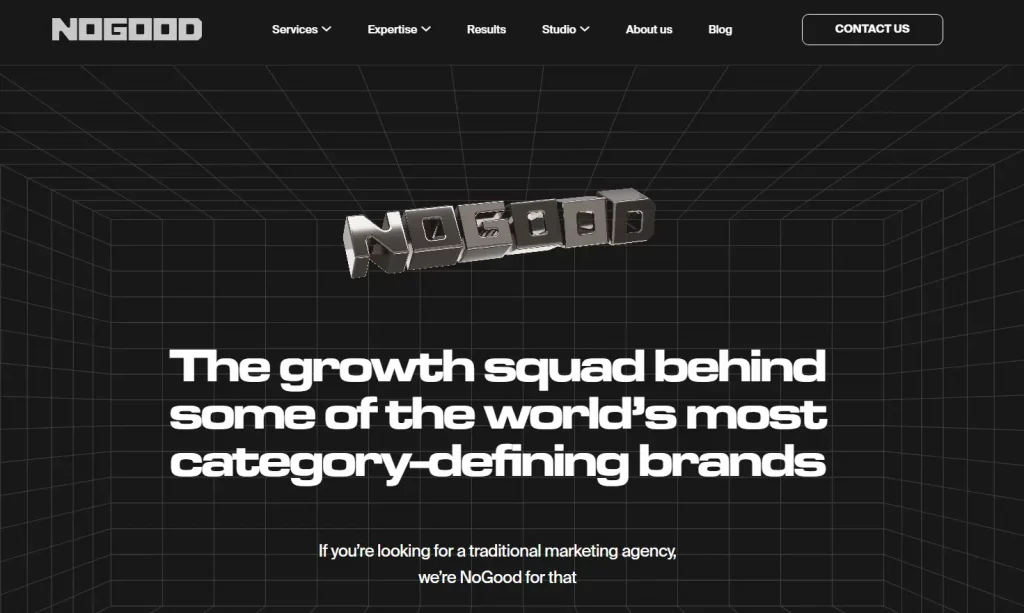
NoGood represents a newer agency model that combines traditional performance marketing with optimization for AI-powered search and answer engines. Its services include SEO, answer engine optimization, generative engine optimization, paid media, conversion optimization, and lifecycle marketing.
The agency has developed its own Goodie AI platform to track and improve brand visibility across tools such as ChatGPT, Perplexity, and Google AI Overviews.
Its AI-search specialization makes it particularly relevant for brands exploring newer forms of product discovery. However, AEO and GEO are still developing areas, so there is less long-term performance data compared with established SEO and paid advertising strategies.

Shopify Marketing Agency comparison
The five agencies above serve different business needs, so there is no single option that fits every Shopify store.
| Agency | Model | Best For | Pricing | Key Strength |
|---|---|---|---|---|
| Common Thread Collective | Full-funnel DTC growth | $10M–$100M DTC brands | Custom | Operator-led growth framework |
| Hawke Media | À la carte / outsourced CMO | Growing brands seeking flexibility | Month-to-month, per service | No long-term lock-in |
| Disruptive Advertising | Paid media & CRO specialist | Brands needing PPC expertise | Retainer or % of ad spend | Advertising efficiency audits |
| WebFX | Full-service + proprietary technology | Brands wanting one full-stack partner | Custom per service | Marketing and attribution technology |
| NoGood | AI-search-native growth | Brands investing in AI search visibility | Custom, project or retainer | AEO and AI visibility |
This comparison highlights an important point when evaluating the best Shopify marketing agency. The strongest option is not necessarily the agency with the longest service list. A better fit depends on the agency’s specialization, pricing structure, business model, and ability to address the store’s most important growth challenge.
How much does a Shopify Marketing Agency cost?
The cost of working with a Shopify marketing agency varies significantly depending on the services involved, advertising budget, store size, and engagement scope. Four pricing structures are particularly common.
| Pricing Model | How It Works | Common For |
|---|---|---|
| Flat monthly retainer | Fixed monthly fee regardless of advertising spend | SEO, CRO, full-service management |
| Percentage of ad spend | Fee increases with the advertising budget managed | PPC and paid social |
| À la carte pricing | Individual services are purchased separately | Flexible, month-to-month engagements |
| Project-based | One-time fee for a defined scope | Audits, campaign launches, and specific projects |
Paid media engagements often use percentage-based pricing because management costs are connected to advertising spend. SEO, CRO, and broader marketing retainers are more likely to use a fixed monthly fee because the work is not directly tied to media spending.
Published pricing is relatively uncommon among agencies. Quotes often depend on site complexity, advertising budget, service scope, and the amount of support required. For this reason, understanding what is included in the engagement is often more useful than comparing headline monthly rates alone.
Questions around reporting frequency, account ownership, access to marketing data, contract terms, and what happens after an engagement ends can also reveal important differences between agencies.
Conclusion
Finding the right Shopify marketing agency is less about choosing the biggest name and more about matching an agency’s expertise with the store’s current needs. A specialist may be the better fit for a specific growth problem, while larger brands may benefit from a full-funnel or full-service model. Reviewing service depth, pricing structure, business stage, and the agency’s experience with Shopify ecommerce provides a clearer basis for comparison and helps identify a marketing partner that can support sustainable growth.
For Shopify stores looking for a professional invoice solution that’s easy to customize without any coding, Vify Shopify Order Printer app is worth considering. Try it for free and see how it fits your store’s needs.