



As ecommerce competition continues to grow, creating a store that stands out requires more than a standard Shopify setup. Shopify web development services provide the technical expertise needed to enhance store performance, implement custom functionality, and deliver a seamless shopping experience across devices. This guide covers everything you need to know about Shopify web development, including its benefits, common service types, and how to choose the right solution for building a high-performing online store.
What are Shopify web development services?
Shopify website development services refer to the specialized technical work involved in designing and building the front-end of your Shopify store — the visual interface your customers interact with every time they visit.
This is distinct from broader Shopify development services, which cover the full spectrum including back-end logic, app development, and integrations. Web development services are specifically focused on:
- How your store looks (UI design)
- How customers move through it (UX)
- How it’s coded and rendered (front-end development)
- How fast and reliably it loads (performance)
In practical terms, Shopify website development services can mean anything from customizing a premium theme to building a completely bespoke storefront from scratch, or even going headless with a decoupled front end powered by a modern JavaScript framework.


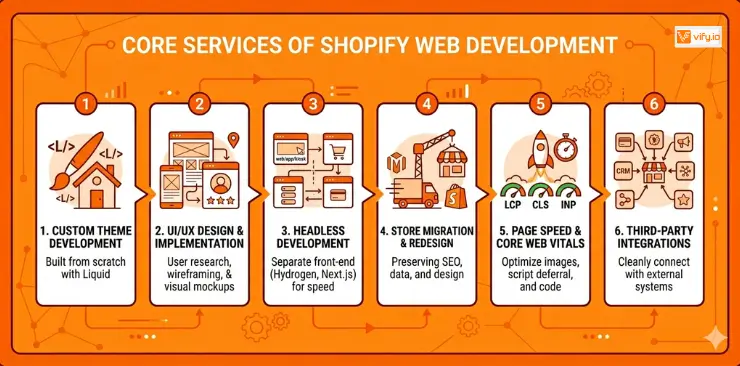
Core services of Shopify web development
A comprehensive Shopify web development project often involves multiple areas of expertise working together to create a high-performing storefront.
1. Custom theme development
For many businesses, custom theme development is the foundation of a web development project. Instead of relying on an off-the-shelf template, developers create or heavily customize a theme using Shopify’s Liquid framework to match specific branding, functionality, and user experience requirements.
This approach provides greater design flexibility and eliminates many of the constraints commonly associated with pre-built themes.
2. Storefront UI/UX design & implementation
Successful Shopify stores are built around the customer journey. Before development begins, teams often work on wireframes, prototypes, and visual concepts to map out how visitors will navigate the site and interact with its content.
Once the design direction is finalized, developers translate those concepts into a fully functional storefront that accurately reflects the intended user experience.
3. Headless Shopify development
Headless commerce represents a more advanced approach to Shopify web development. In this architecture, Shopify continues to manage ecommerce functionality such as inventory, checkout, and payments, while the storefront is built separately using technologies like Shopify Hydrogen, Next.js, or Nuxt.js.
This setup offers greater design flexibility, faster performance, and the ability to deliver consistent experiences across multiple digital touchpoints. However, it also requires a larger technical investment and ongoing maintenance.
4. Shopify store migration & redesign
Businesses often seek web development support when migrating from platforms such as WooCommerce or Magento, or when refreshing an existing Shopify store.
A well-executed migration or redesign involves transferring content, preserving SEO value, implementing proper URL redirects, and modernizing the storefront without disrupting business operations or search visibility.
5. Page speed & core web vitals optimization
Store speed has a direct impact on both user experience and conversion rates. As a result, many Shopify web development projects include performance-focused enhancements designed to improve Core Web Vitals metrics, including Largest Contentful Paint (LCP), Cumulative Layout Shift (CLS), and Interaction to Next Paint (INP).
Common optimization tasks include image compression, code refinement, lazy loading implementation, and reducing unnecessary scripts that can affect loading times.
6. Third-party integrations
Most ecommerce businesses rely on multiple tools and platforms beyond Shopify itself. Web development services often involve connecting the storefront with external solutions such as payment gateways, CRM systems, ERP software, customer review platforms, email marketing tools, and loyalty programs.
When implemented correctly, these integrations create a more seamless experience for both customers and store operators while maintaining strong site performance.
The Shopify web development process
Knowing how a typical Shopify web project unfolds can help you plan more effectively, allocate resources appropriately, and establish realistic expectations when working with a development partner. While every project differs in scope, most Shopify web development services follow a structured process to ensure the final store meets both business and technical requirements.
Step 1: Discovery & Planning
The project begins with a discovery phase, where the developer or agency gains a thorough understanding of your business, target audience, competitive landscape, and project goals. Discussions typically cover branding direction, desired functionality, design inspirations, technical requirements, and expected launch timelines.
This stage lays the foundation for successful web development services Shopify projects by ensuring everyone is aligned before design and development work begins.
Step 2: Wireframing & Site Structure
Once requirements are defined, the team creates wireframes to map out the structure and user flow of key pages, including the homepage, collection pages, product pages, cart, and checkout.
These low-fidelity layouts focus on content hierarchy and navigation rather than visual styling, helping stakeholders validate the overall user experience before moving into design.
Step 3: Visual Design Creation
After wireframes are approved, designers develop high-fidelity mockups that showcase the final look and feel of the store. This phase establishes the visual identity of the site, including typography, color schemes, imagery, and UI components.
Most Shopify web development services require design approval at this stage before any coding begins, reducing the likelihood of costly revisions later in the project.
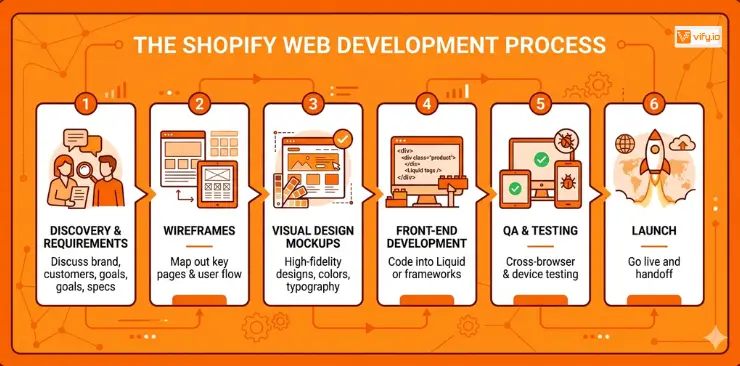
Step 4: Front-End Development
With designs finalized, developers transform the approved mockups into a fully functional storefront. Depending on the project’s complexity, this may involve building with Shopify’s Liquid framework or using modern technologies such as Hydrogen, Next.js, or other headless architectures.
The objective is to deliver a responsive, high-performing storefront that accurately reflects the approved design while maintaining excellent usability across all devices.
Step 5: Quality Assurance & Testing
Before launch, comprehensive testing is conducted to identify and resolve any issues. This typically includes cross-browser compatibility checks, mobile responsiveness testing, performance optimization, accessibility reviews, and validation of all store functionality.
Professional web development services Shopify providers dedicate significant time to this stage to ensure a smooth customer experience from day one.
Step 6: Launch & Post-Launch Support
Once testing is complete, the store is deployed to the live environment. Domain settings are updated, final checks are performed, and the site becomes publicly accessible.
Most Shopify web development services also include a post-launch monitoring period, allowing the development team to address any unexpected issues, fine-tune performance, and ensure a seamless transition to the new storefront.
Conclusion
A well-executed Shopify storefront is one of the highest-leverage investments you can make in your ecommerce business. The right Shopify web development services deliver a faster, more conversion-friendly, and more on-brand store experience that pays for itself over time.
For a broader look at what professional development can do for your Shopify store, visit our guide to Shopify development services. And if you need custom functionality that goes beyond the storefront, our guide on Shopify app development services is the next step.
If you’re selling on Shopify and need a professional invoice solution, then Vify Shopify Order Printer app is the best choice for you. Try it for free today and experience it for yourself. We’re confident you’ll love it.