

Shopify transaction fees are easy to underestimate because they are not one charge. Every online sale carries a card rate, some sales carry a second Shopify fee on top, and a handful of order types trigger extras such as premium cards, international cards, or currency conversion. Which of these hits a given order depends on one thing: which payment provider processed it. This guide sorts out Shopify transaction fees by payment method, shows what the charges look like on real orders from $15 to $200, and compares a typical month of sales with and without Shopify Payments.
3 kinds of Shopify transaction charges
It helps to separate the charges before comparing them:
- The card rate: a percentage plus a fixed amount that you pay on every card sale. With Shopify Payments, this is the only fee on most orders.
- The third-party transaction fee: an extra percentage Shopify adds when an outside payment provider processes an order.
- Situational charges: premium and international card surcharges, currency conversion, and chargeback fees.
For the broader picture of subscription, app, and add-on costs, see our guide to Shopify fees. This article stays focused on what happens to each sale.
Which transaction fee applies to which payment method
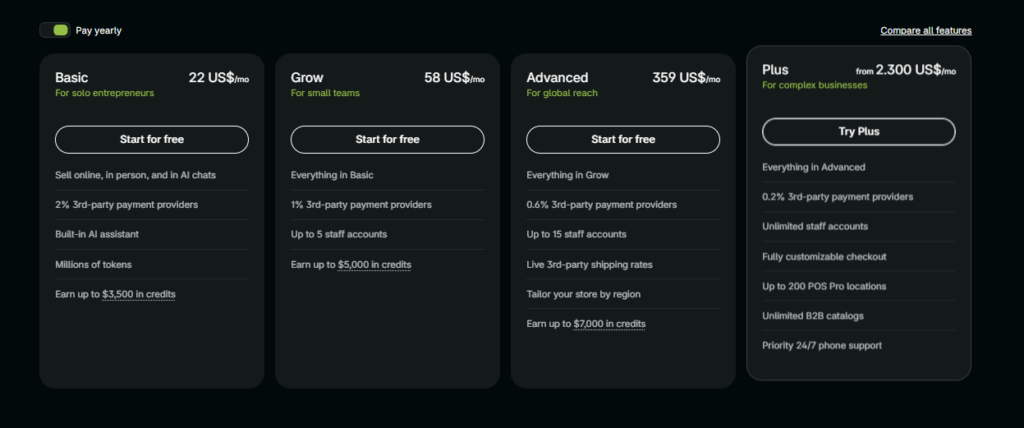
The quickest way to predict the transaction fees on Shopify for any order is to look at how the customer paid. This table assumes your store has Shopify Payments active as its primary provider unless the row says otherwise.
| How the customer pays | Card rate | Third-party transaction fee |
|---|---|---|
| Card through Shopify Payments (including Apple Pay, Google Pay) | Yes | No |
| Shop Pay | Yes, at your Shopify Payments rate | No |
| Shop Pay Installments | Yes, at a higher rate shown in your admin | No |
| PayPal Express Checkout | PayPal’s own fees | No |
| Cash, cash on delivery, bank transfer (manual methods) | None from Shopify | No |
| Outside card provider as your main processor | Provider’s own fees | Yes, 2% to 0.2% by plan |
| Order partly paid with a gift card or store credit | Card rate on the card part | Yes, on the gift card or credit part, for stores created on or after May 12, 2025 |
The takeaway is that Shopify Payments removes the second fee from nearly every order. Choosing a provider is the largest single lever you have over the transaction fees on Shopify and your wider Shopify transaction costs. If you are still deciding between processors, our guide to Shopify Payments explains eligibility and how it works.
Shopify transaction fees by plan
These rates apply when Shopify Payments processes the order:
| Payment type | Basic | Grow | Advanced | Plus |
|---|---|---|---|---|
| Online standard card | 2.9% + 30¢ | 2.7% + 30¢ | 2.5% + 30¢ | 2.25% + 30¢ |
| Online premium card (for example American Express, business cards) | 3.5% + 30¢ | 3.3% + 30¢ | 3.1% + 30¢ | 2.95% + 30¢ |
| Online international card | add 1% | add 1% | add 1% | add 1% |
| In-person card | 2.6% + 10¢ | 2.5% + 10¢ | 2.4% + 10¢ | 2.3% + 10¢ |
Plus rates are a published starting point, and Shopify says Plus card rates vary by country and can be arranged through its sales team.
Two details cause most surprises. American Express and business cards fall under the premium rate, so if your customers use them often, your blended rate will sit above the headline figure. And the fixed 30¢ is the same on every plan, which matters a lot on small orders, as the next section shows.
Third-party Shopify transaction fees
If you use an outside payment provider instead of Shopify Payments, Shopify adds its own fee on top of what your provider charges you:
| Plan | Third-party transaction fee |
|---|---|
| Basic | 2% |
| Grow | 1% |
| Advanced | 0.6% |
| Plus | 0.2% |
Shopify describes these as charges that apply when Shopify Payments is not available in your country or when you choose not to use it. Your outside provider charges its own card rates separately.
What a month of sales looks like:
To see the difference, take a store that sells $10,000 a month across 125 orders of $80. The comparison below assumes an outside provider that charges 2.9% + 30¢, a common headline rate used here purely for illustration, so your actual provider’s terms will change the totals.
| Monthly cost | Basic | Grow | Advanced |
|---|---|---|---|
| Card rate through Shopify Payments | $327.50 | $307.50 | $287.50 |
| Outside provider plus Shopify’s fee | $527.50 | $407.50 | $347.50 |
| Extra cost of the outside provider | $200 | $100 | $60 |
| Extra cost per year | $2,400 | $1,200 | $720 |
The gap shrinks as the plan rises, which is why merchants who cannot use Shopify Payments often reach the break-even point for upgrading sooner. Whether an upgrade pays off depends on comparing these savings with the extra subscription cost, a calculation we cover in our plan comparison.
3 situations that trigger extra Shopify transaction charges
1. Gift cards and store credit
For stores created on or after May 12, 2025, Shopify’s Help Center says orders that include store credit or gift cards as a payment method are charged third-party transaction fees on the amount paid with them, even when Shopify Payments handles the rest of the order. Stores created before that date are not affected.
Here is what that looks like on Basic for a $100 order paid with a $40 gift card and a $60 card. The card part costs 2.9% + 30¢ on $60, which is $2.04. The 2% fee on the $40 gift card amount adds $0.80, for a total of $2.84. On Grow, the extra is $0.40, and on Advanced it is $0.24.
One point needs checking before you rely on it. Earlier Help Center wording said Plus stores using Shopify Payments as their only provider had this fee waived, but some current analyses report that newer pages no longer carry that sentence. If you are on Plus, confirm the current policy with Shopify.
2. Mixing payment providers
Running Shopify Payments alongside a direct third-party card provider has a cost of its own. According to Shopify’s Help Center, when an outside provider stays your primary processor, transactions that Shopify Payments handles, such as Shop Pay, are charged at standard Shopify Payments rates plus a 1.25% premium. On Basic, that turns a 2.9% + 30¢ Shop Pay order into 4.15% + 30¢. On an $80 order, that is $3.62 instead of $2.62.
3. Currency conversion
If you charge customers in their own currency, Shopify converts the payment into your store currency. US stores pay a 1.5% conversion fee on those orders, separate from the 1% international card surcharge, so a foreign customer paying in a local currency with a foreign card can trigger both. The conversion fee is not returned if you refund the order.

Refunds and Chargebacks
Two rules are easy to miss because they only show up when something goes wrong.
First, Shopify’s Help Center says credit card transaction fees are not returned when you issue a refund. On Basic, refunding an $80 order still leaves you out $2.62 in processing.
Second, a lost chargeback costs the disputed amount plus a $15 fee for US stores. The fee is returned if you win the dispute. Because the original card rate is already spent by then, a lost $120 order on Basic costs about $138.78 plus the product you shipped: $3.78 in processing, the $120 payment taken back, and the $15 fee.
Conclusion
Shopify transaction fees come down to one decision and a few exceptions. If Shopify Payments processes your orders, you pay the card rate for your plan and little else. If an outside provider does, you pay that provider plus Shopify’s 2% to 0.2%. The exceptions are gift cards on newer stores, mixed providers, currency conversion, and fees that refunds and lost disputes never give back. Measure your blended rate once a month, and the rest of your Shopify transaction costs become far easier to manage.
For Shopify stores looking for a professional invoice solution that’s easy to customize without any coding, Vify Shopify Order Printer app is worth considering. Try it for free today and see how it fits your store’s needs.
FAQs
What are the transaction fees on Shopify?
With Shopify Payments, you pay only the card rate for your plan, which is 2.9% + 30¢ on Basic, 2.7% + 30¢ on Grow, 2.5% + 30¢ on Advanced, and 2.25% + 30¢ on Plus for standard US online cards. With an outside payment provider, Shopify adds a third-party transaction fee of 2%, 1%, 0.6%, or 0.2% depending on your plan.
Does Shopify charge a transaction fee on every sale?
No. When you use Shopify Payments as your main provider, there is no third-party transaction fee on orders paid through Shopify Payments, Shop Pay, PayPal Express, or manual methods such as cash, cash on delivery, and bank transfer. You still pay the card rate on card sales.
How can I avoid Shopify transaction fees?
Use Shopify Payments as your primary processor where it is available, and avoid splitting volume with a direct outside card provider. Keep in mind that stores created on or after May 12, 2025 can still be charged a third-party fee on the gift card or store credit portion of an order.
What is the difference between a transaction fee and a payment processing fee?
The payment processing fee, or card rate, is charged on card payments and covers the processing itself. The third-party transaction fee is Shopify’s extra charge for orders processed by a provider other than Shopify Payments. You can avoid the second, but not the first.
Are Shopify transaction costs refunded when I refund an order?
No. Shopify says credit card transaction fees are not returned when you issue a refund, and the currency conversion fee is not returned either. A refunded order still costs you its original processing fee.
Why was I charged a transaction fee on a gift card order?
For stores created on or after May 12, 2025, Shopify charges its third-party transaction fee on the part of an order paid with a gift card or store credit, even if Shopify Payments processes the rest. Stores created before that date are not affected.